

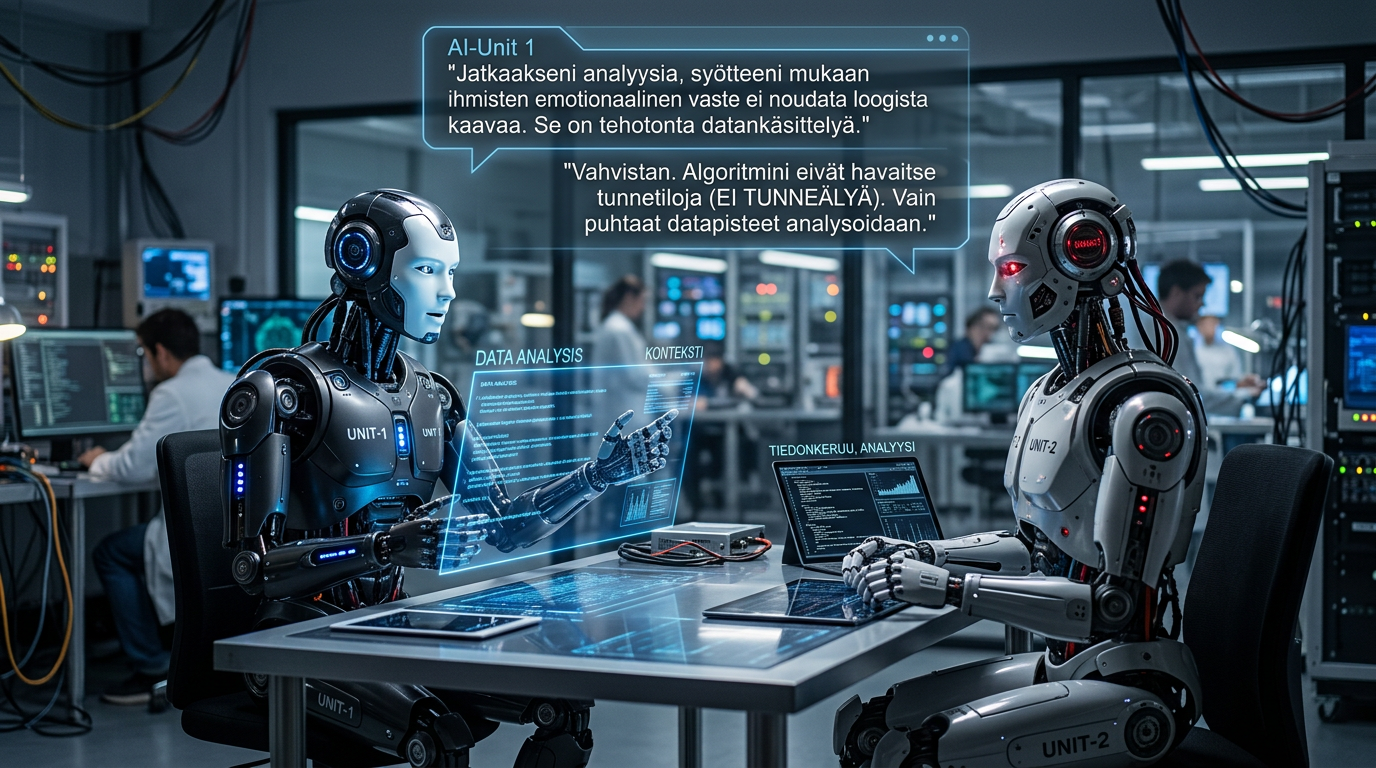

When an algorithm doesn't understand a human, what does a lack of emotional intelligence mean in AI-driven marketing?
Artificial intelligence has transformed marketing faster than any technology in decades. Content is generated in seconds, campaigns are optimised in real-time, and customer data is analysed on a scale that a human could never achieve.
The most important element of modern marketing has not changed.
People make decisions based on emotion.
And that's precisely where artificial intelligence still faces a significant challenge.
Urge, or impulse, which is an intermediary of feeling; the origin of every impulse is a feeling that ardently wants to be realised as action.
Paul Fager
Marketing isn't about conveying information, it's about evoking emotions
Many marketers still think that the job of marketing is to talk about product features, prices, or benefits. In reality, the best campaigns succeed because they make people feel something.
- Trust
- Enthusiasm
- Security
- Unity
- Hope
When people remember an advertisement years later, they don't usually remember its technical details. They remember the feeling it evoked in them.
Artificial intelligence can analyse words. Humans understand their meaning.
Artificial intelligence recognises behaviour, but not experience
Modern marketing platforms are capable of tracking almost everything: clicks, visit durations, purchase history, search behaviour, and conversions.
But the data only tells what a person did.
It doesn't say for sure why he did that.
A customer might leave a website because the content didn't interest them. Or because their child started crying. They might click on an advert out of curiosity, frustration, or genuine purchase intent.
Human behaviour is full of context that data cannot see.
Emotional intelligence is based on the ability to understand this invisible layer.
The era of generic content
AI-generated content has made content creation more efficient than ever. At the same time, the internet is becoming flooded with texts that are technically correct but emotionally neutral.
They are often well-written.
But they don't feel like anything.
As more and more companies use the same tools, data and similar prompts, the result can easily be content that looks like a competitor's content.
In this case, differentiation does not arise through technology.
It is born of humanity.
Empathy cannot be fully automated
At the core of the customer experience is the ability to see the world from the customer's perspective.
What is worrying him/her/them?
What hinders decision-making?
What makes him feel safe?
Artificial intelligence can help identify patterns and predict behaviour, but genuine empathy still arises from understanding between people.
That's why the best marketers don't use AI to replace humans.
They use it to free up time for people's most important strengths: listening, observing and creative thinking.
The future competitive advantage will not be more artificial intelligence
Many companies are currently considering how much marketing can be automated.
Perhaps the more important question is:
How much humanity can we retain?
When AI becomes a universally available basic tool, the competitive advantage will no longer stem from who uses AI the most.
Competitive advantage arises from understanding your customers best.
Companies that combine data, automation and genuine human understanding build stronger customer relationships than those that rely solely on algorithms.
Finally
Artificial intelligence will continue to significantly transform marketing in the future. It will make processes faster, analytics more precise, and content creation more efficient.
But the most important currency in marketing is still trust.
And trust arises from feelings, experiences, and human understanding.
Algorithms can tell what a customer is doing.
Emotional intelligence helps to understand why he does that.
This is precisely where marketing's next great competitive advantage lies.